


This list isn’t comprehensive but a collection of some of the most useful quilting charts, formulas and online tools to help you design your quilts. If you know of other tools, charts or formulas please add a comment.
Quilt sizes and quilt backing fabric
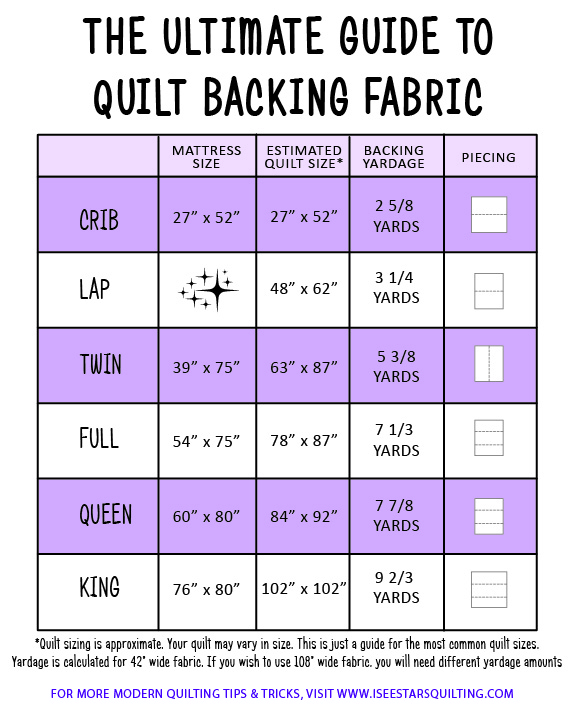
Christen from I see stars quilting has put together this fantastic guide to help us work out:
- the quilt size you need for a particular mattress size
- how much fabric you need and
- how to piece it
Not only she has made this chart but she also tells us all about backing your quilt. Visit her site for details.
Binding calculator
Not a chart but this binding calculator helps you work out how many strips you need for a quilt and how much fabric to buy.
Inches to centimetres conversion
A table but also an online calculator that will convert between inches, yards in decimal form, yards in fractional form, and centimetres.
How many blocks in a quilt
Make Modern Magazine made this very useful chart that shows you how many blocks you need to make a quilt based on block size, with or without sashing.

Precut fabric sizes
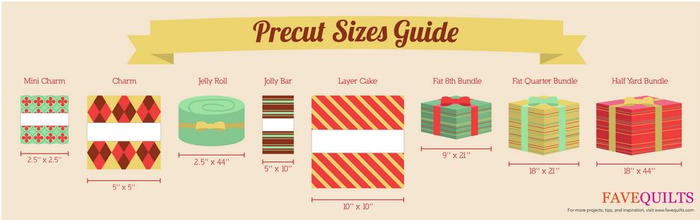
- Mini charm: 2.5″ x 2.5″ – 6.35cm x 6.35cm
- Charm squares: 5″ x 5″ – 12.7cm x 12.7cm
- Jelly roll: 2.5″ x 44″ – 6.35cm x 112c
- Jolly bar: 5″ x 10″ – 12.7cm x 25.4cm
- Layer cake: 10″ x 10″ – 25.4cm x 25.4cm
- Fat eighth: 9″ x 21″ or 11″ x 18″ – 22.86cm x 53.3cm or 28cm x 45.7cm
- Fat quarter: 18″ x 21″ – 45.7cm x 53.3cm
- Half yard: 18″ x 44″ – 45.7cm x 112cm
- One yard: 36″ x 44″ – 91.4cm x 112cm
There’re many ways to use precuts.
Some patterns are written for precuts white others, particularly the larger precuts, often are cut into smaller sizes.
Most often it’s fat quarters. Patchwork posse has a very good article on cutting a fat quarter into different sizes with different options.
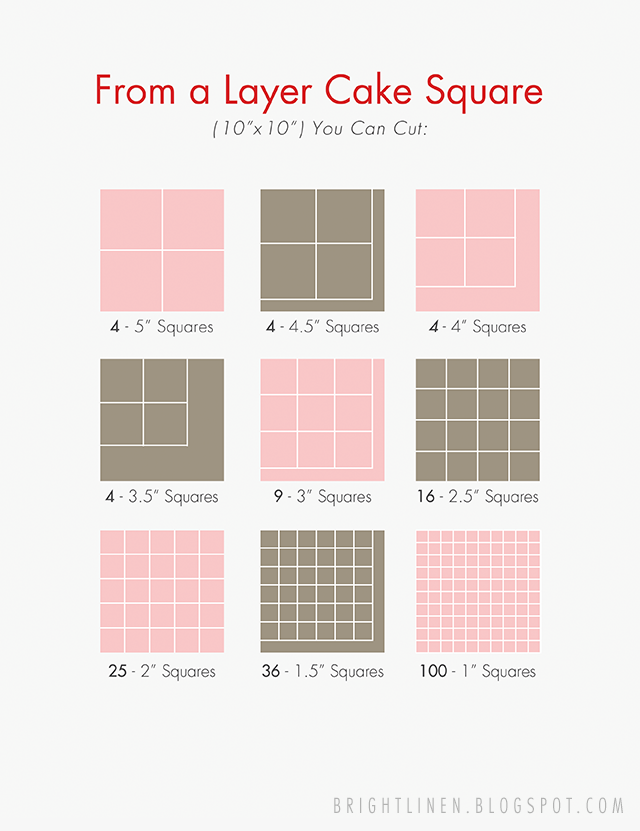
Also this chart shows you how many squares of a particular size you can cut from a fat quarter.

and laye cakes:
Traditional half square triangle (HST) method chart
This is the two at a time method demonstrated on video:
I refer to Blossom heart quilts chart frequently to work out my HSTs:

Flying geese chart and formula
This is a video demo of the no waste flying geese. Use the formula below to make the block in different sizes.

Courthouse steps or log cabin yardage requirements
This extremely useful chart is for a number of block sizes.
But first watch a short demonstration of this block:

Half log cabin blocks
Watch my video demo for this block:

Square in a square
Watch a video demo:

Quarter square triangles chart
This video demonstrates how to make a quarter square triangle. Use the formula below to make the block in different sizes and check Bonjour quilts post for more information on the formula.
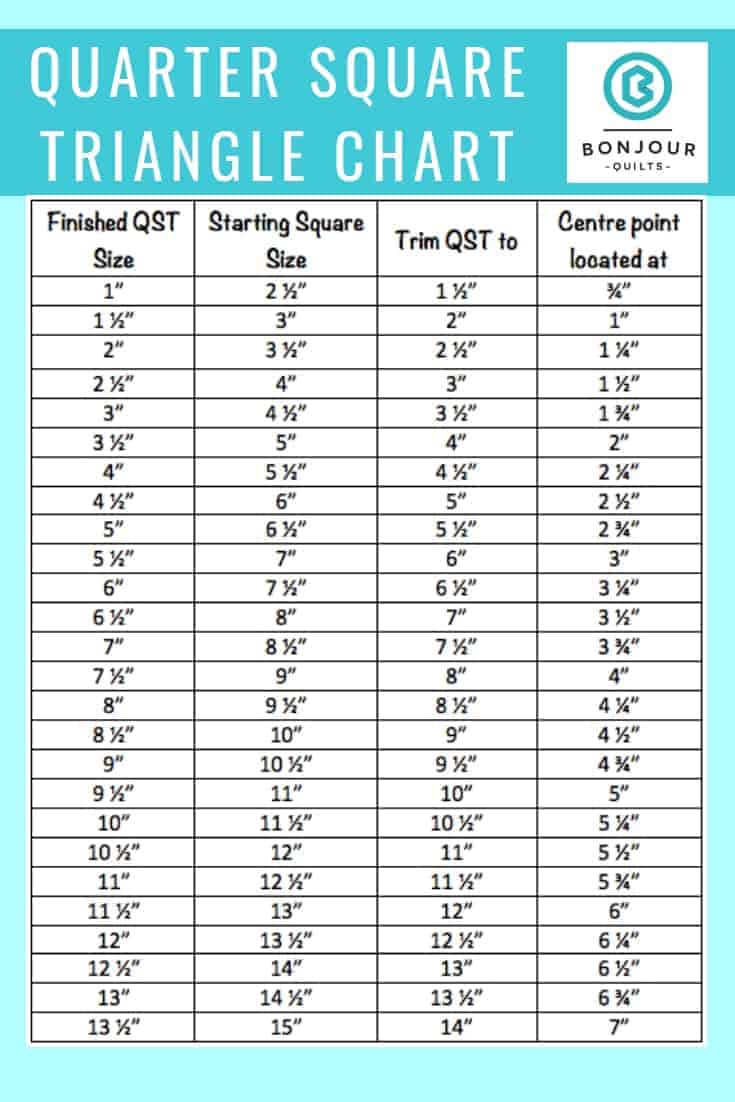
Set in and corner triangles
This chart is very handy when making a quilt on point.

But what’s an on point quilt?
An on-point quilt is assembled in diagonal rows, providing a unique visual appeal compared to traditional layouts.
Each diagonal row begins and ends with either a corner setting triangle or a side setting triangle, which helps maintain the quilt’s overall structure and aesthetics.
Corner setting triangles are placed at the corners of the quilt, while side setting triangles are used along the edges, contributing to a balanced and visually interesting design.
For those looking to delve deeper into this aspect of quilting, Julie Baird of Generations Quilt Patterns offers an in-depth explanation on setting triangles for an on-point quilt. Her insights not only clarify the purpose of these triangles but also provide practical tips and techniques that can enhance your quilting experience.
By understanding how to effectively incorporate setting triangles, quilters can explore various patterns and styles, ultimately expanding their creative repertoire.
Check out this Corner and Setting Triangle Dimensions for Common Block Sizes (pdf) chart.
And last but not least…
I wanted to share this very special PDF of charts by Deborah Paul that she compiled herself and shared with us. This may be useful as one pager to have handy when working out a design.
Join my Patreon page

Get a new video tutorial every week plus other exclusive perks with 3 membership tiers.
Stay connected
Subscribe to my blog, follow me on YouTube , Instagram or join my Facebook group and Facebook page.
My book and other publications
You can now purchase individual chapters from my book as bundles of 4 unique quilt patterns.
If you prefer to own the complete book, Turnabout Patchwork, please note it is currently out of print. However, you might still be fortunate enough to find a copy on Amazon.
Explore all the quilts from the book in real-life projects!

This post has affiliate links.
 teresadownunder.com
WOW….there is so much great information in this email.
Thank you so much Teresa!! BTW….I love watching your videos and
often end up taking screen shots to keep as inspirations for future
projects!!!
Were are you in Australia? My husband and I spent 6 years in Canberra
way back in the 1980’s….he did his PhD at Australian National
University. It was a great experience for us and we have so many
wonderful memories of the people there!!
Cheers….
Frances
http://www.francesquilts.com
LikeLiked by 1 person
Tanks a lot for all informations, long life to your projects and life, with love
LikeLiked by 1 person
This is absolutely fantastic; THANK YOU FOREVER !!!
LikeLiked by 1 person
Very useful. Thank you for this free information. I watch most of you videos. Not all because I want to use your techniques. Cathy/USA
LikeLiked by 1 person
These charts are extremely helpful. Thank you, so much.
Elaine
Sent from my iPad
>
LikeLiked by 1 person
Hi Teresa, I love your emails so much. I have a folder labeled SEWN UP. Today’s email is a really loaded email. Loaded with so much great information and your patterns. I also have your book. I look forward to seeing your emails everyday. Thanks from Lil in Michigan
LikeLiked by 1 person
Thank you! This email made my day! Such good and helpful info. Again, thank you Ellie Guhl
Sent from AT&T Yahoo Mail for iPhone
LikeLiked by 1 person
Wow, Teresa! You outdid yourself. These charts are great. Thank you, Dottie
LikeLiked by 1 person
WOW! WOW! WOW! Teresa !!!…THANK YOU SO MUCH!….what a great help this is! (((((((((((((((((hugs))))))))))))))))) Elizabeth
LikeLiked by 1 person
WOW! How nice of you to share all this information in one place! Thank you so much for your generosity.
LikeLiked by 1 person
Thank you so very helpful
LikeLiked by 1 person
There is a wealth of useful information in this post. Thank you for generously sharing it with us
LikeLiked by 1 person
Wow!! What a bunch of really useful info!! Thank you!!
Sent from my iPhone
>
LikeLiked by 1 person